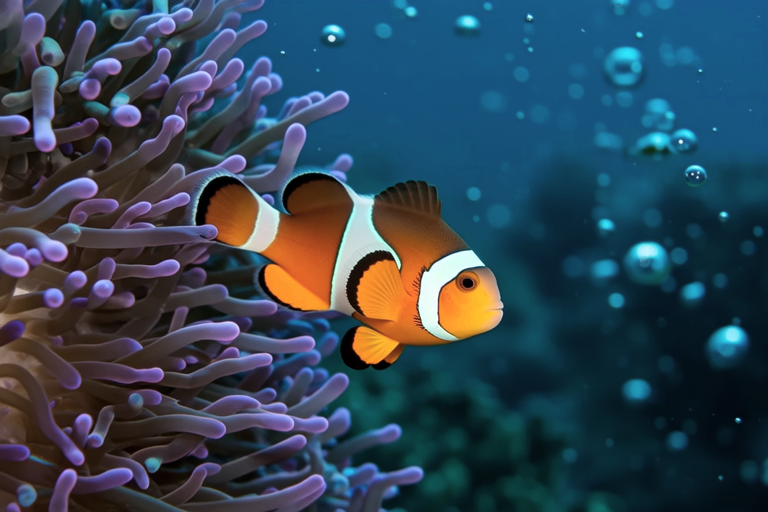
Exploring Clownfish: A Dive into Their Underwater World
Imagine a vibrant coral reef teeming with life, where colorful fish dart between the branches of soft corals and the tentacles of sea anemones sway gently in the current. Among these aquatic inhabitants, one species stands out for its striking appearance and intriguing behaviors – the clownfish. These small, brightly colored fish have captured the hearts of many, not just because of their vibrant hues and distinctive patterns, but also due to their remarkable adaptations and complex social structures.
The Symbiotic Relationship with Sea Anemones
Clownfish are perhaps best known for their close association with sea anemones. This mutually beneficial relationship, known as symbiosis, is a cornerstone of their survival in the ocean. Sea anemones are cnidarians that possess stinging cells called nematocysts, which they use to capture prey and protect themselves from predators. While most fish would be deterred by these potent defenses, clownfish have evolved a special adaptation that allows them to live among the anemone’s tentacles without being harmed.
Scientists have discovered that the mucus coating on the clownfish’s skin contains a compound that neutralizes the anemone’s sting. This protective layer enables the clownfish to coexist peacefully with their host, offering them refuge from larger predators and providing access to food particles that drift near the anemone. In return, the clownfish helps the anemone by attracting potential prey with their movements and deterring butterflyfish, which feed on anemones. This intricate dance of mutualism showcases the delicate balance of life in the reef ecosystem.
Complex Social Structures
Beyond their relationship with sea anemones, clownfish exhibit fascinating social behaviors within their reef communities. They live in groups composed of a single breeding pair and several non-breeding individuals. The dominant female and male are responsible for reproduction, while the subordinate members assist in caring for the eggs and protecting the territory.
The hierarchy within a clownfish group is maintained through a strict dominance structure. If the dominant female dies, the largest male quickly transforms into a female, taking over the role of the breeding partner. This ability to change sex is known as sequential hermaphroditism and ensures the continuity of the population. Such adaptability underscores the complexity of clownfish social dynamics and highlights the importance of maintaining stable group compositions for their survival.
Adaptations to Thrive in Marine Environments
Clownfish have developed a range of physiological and behavioral adaptations that allow them to thrive in diverse marine environments. One notable adaptation is their ability to regulate their internal pH levels, which helps them cope with the changing acidity of their surroundings. This skill is particularly crucial given the ongoing threat of ocean acidification caused by increased carbon dioxide levels in the atmosphere.
In addition to their physiological adaptations, clownfish demonstrate remarkable resilience when it comes to adapting to different habitats. Some species prefer shallow waters near the shore, while others venture deeper into the ocean, inhabiting areas with strong currents and lower light conditions. This versatility in habitat selection has contributed to their widespread distribution across tropical and subtropical regions around the world.
Reproductive Habits
The reproductive cycle of clownfish begins with courtship rituals that involve elaborate displays of coloration and movement. Once a pair has established their bond, they prepare a nesting site near the base of their host anemone. The male then takes on the primary responsibility of caring for the eggs, fanning them with his fins to ensure proper oxygenation and warding off potential threats.
After approximately one week, the eggs hatch, releasing tiny larvae into the water column. These microscopic creatures drift with the currents for several days before settling on suitable substrates to begin their lives as juvenile clownfish. This early-stage dispersal strategy increases the chances of finding new habitats and reduces competition for resources within the existing population.
Challenges in the Wild
Despite their adaptations and symbiotic relationships, clownfish face numerous challenges in their natural habitats. Habitat destruction, pollution, and climate change pose significant threats to their survival. Coral bleaching events, caused by rising sea temperatures, can lead to the death of coral reefs and the sea anemones that provide shelter for clownfish. Additionally, overfishing and the aquarium trade contribute to declines in local populations.
Efforts are underway to mitigate these impacts through conservation initiatives aimed at protecting critical habitats and promoting sustainable fishing practices. However, addressing the broader issue of climate change remains a formidable challenge that requires global cooperation and action.
Recent Scientific Discoveries
Advancements in genetic research have shed new light on the evolutionary history of clownfish and their relationships with other species. By analyzing DNA sequences, scientists have been able to trace the origins of this family of fish and identify distinct lineages that have evolved independently in response to varying environmental pressures.
Another exciting development involves the discovery of novel compounds produced by clownfish and their associated bacteria. These chemicals may hold promise for medical applications, including treatments for inflammation and infections. Further investigation could unlock valuable insights into drug development and enhance our understanding of marine ecosystems.
Conclusion
From their symbiotic partnerships with sea anemones to their complex social structures and remarkable adaptations, clownfish offer a window into the wonders of marine biodiversity. As we continue to explore and learn more about these captivating creatures, it becomes increasingly clear that their survival depends on our commitment to preserving the health of our oceans. By fostering awareness and supporting conservation efforts, we can help ensure that future generations will have the opportunity to witness the magic of clownfish in their natural habitats.
