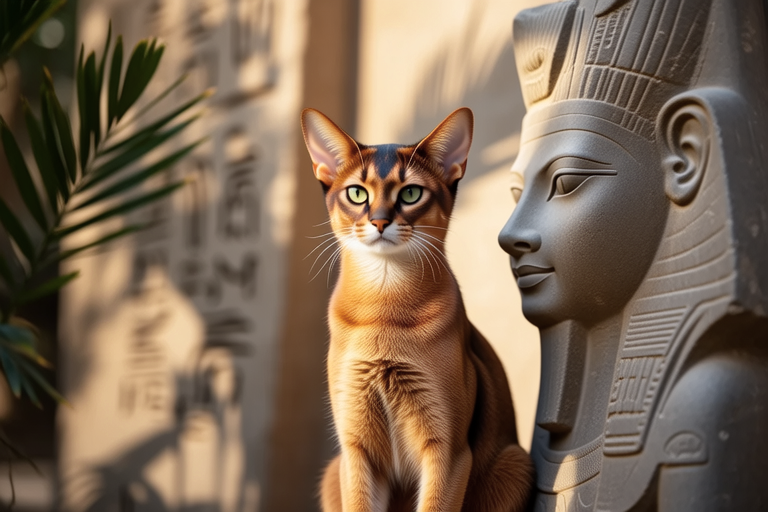
The Historical Roots and Genetic Lineage of the Abyssinian Cat
The Abyssinian cat, known for its distinct ticked coat and lively temperament, has captivated human hearts for centuries. This article explores the historical roots and genetic lineage of the Abyssinian cat, tracing its origins back to ancient civilizations. We will examine archaeological findings, cultural representations, and historical texts that mention or depict cats similar to the Abyssinian. Additionally, we will analyze theories about migration and adaptation, discuss modern scientific studies on the breed’s DNA, and compare and contrast Abyssinian characteristics with those of their wildcat ancestors. Finally, we will conclude with the significance of understanding these origins for contemporary Abyssinian care and breeding practices.
Archaeological Findings and Cultural Representations
Archaeological evidence suggests that cats similar to the Abyssinian have been around for thousands of years. Ancient Egyptian tombs, dating back to 1450 BCE, depict felines with a similar appearance to the Abyssinian. These cats were often depicted with slender bodies, large ears, and distinctive markings. The Egyptians revered cats as sacred animals, associating them with various deities such as Bastet, the goddess of fertility and protector of households. Cats played a crucial role in controlling rodent populations, which was essential for maintaining grain stores.
In addition to Egypt, other ancient civilizations, including Persia and India, also had a rich history of domesticated cats. Persian artifacts from the 7th century BCE show cats with a resemblance to the Abyssinian. Similarly, Indian sculptures from the 1st century BCE portray cats with a ticked coat, suggesting a long-standing presence of similar breeds in the region.
Historical Texts and Migration Theories
Historical texts further support the idea of an ancient Abyssinian-like cat. The Book of Tobit, written around the 2nd century BCE, mentions cats as valuable companions. The text describes a cat that saved a man from a deadly snake, highlighting the close relationship between humans and cats during this period. Additionally, Greek historian Herodotus, writing in the 5th century BCE, noted that cats were highly valued in Egypt due to their ability to control pests.
Theories about the migration of these cats vary. Some believe that they traveled along trade routes from Egypt to Asia and Europe. Others suggest that they migrated independently, adapting to new environments as they spread across continents. The genetic diversity observed in modern Abyssinians supports the idea of multiple migration paths and interbreeding with local wildcats.
Modern Scientific Studies on DNA
Advancements in genetic research have provided new insights into the Abyssinian’s ancestry. A study published in Nature Communications in 2017 analyzed the DNA of ancient Egyptian cats and compared it to modern breeds, including the Abyssinian. The study found that the genetic makeup of ancient Egyptian cats closely resembles that of modern Abyssinians, supporting the theory that these cats originated in Egypt and later spread to other regions.
Another study, conducted by researchers at the University of California, Los Angeles, examined the mitochondrial DNA of Abyssinians and related breeds. The results revealed that Abyssinians share common ancestors with wildcats native to Southeast Asia and Africa. This suggests that the breed’s development involved interbreeding with local wildcats, leading to the unique physical traits seen today.
Comparing Abyssinian Characteristics with Wildcat Ancestors
Abyssinian cats exhibit several characteristics reminiscent of their wildcat ancestors. They have a sleek, muscular build, large ears, and almond-shaped eyes, all of which contribute to their agility and alertness. Their coat pattern, known as ticking, is also similar to that of certain wildcats, providing camouflage in their natural habitat.
Evolutionary adaptations have allowed Abyssinians to thrive in various environments. For instance, their thin, dense coat is well-suited for warm climates, while their keen senses enable them to hunt effectively. Modern Abyssinians retain many of these traits, but they have also developed social behaviors that make them excellent companions for humans.
The Significance of Understanding Origins for Contemporary Care and Breeding Practices
Understanding the historical roots and genetic lineage of the Abyssinian cat is crucial for contemporary care and breeding practices. Knowledge of their ancestry can help veterinarians and breeders identify potential health issues, such as genetic disorders or sensitivities to certain environmental factors. By studying the breed’s evolution, we can also develop strategies to preserve genetic diversity and promote the overall health and well-being of Abyssinian cats.
Caregivers can benefit from this knowledge by providing appropriate nutrition, exercise, and enrichment activities that cater to the breed’s specific needs. For example, Abyssinians require mental stimulation and opportunities for physical activity, given their high energy levels and curiosity. Additionally, breeders can use this information to make informed decisions about breeding programs, ensuring that future generations of Abyssinians inherit the best traits while minimizing the risk of inherited diseases.
In conclusion, the historical roots and genetic lineage of the Abyssinian cat offer valuable insights into its development and adaptation over time. By examining archaeological findings, cultural representations, historical texts, migration theories, and modern scientific studies, we can better understand the breed’s origins and its place in human history. This knowledge is essential for contemporary Abyssinian care and breeding practices, helping to ensure the continued health, happiness, and prosperity of this beloved breed.
