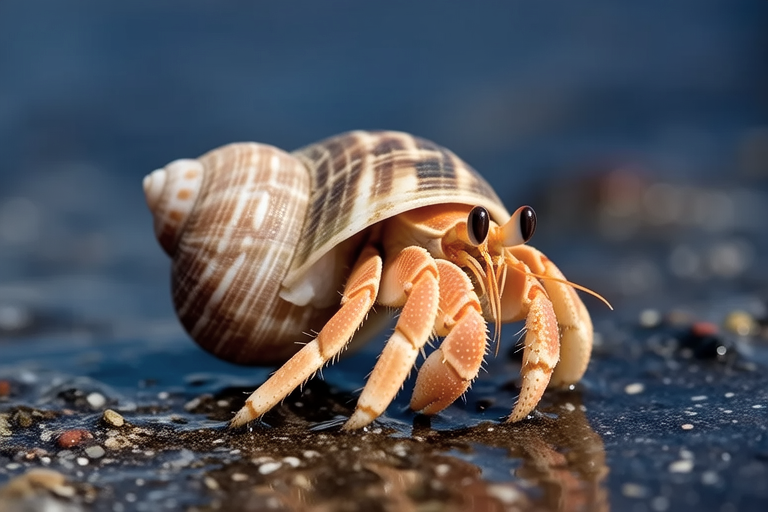
The Intriguing Life of Hermit Crabs: A Dive into Their Unique Behaviors and Roles
Hermit crabs are fascinating creatures that have captured the imagination of many with their peculiar ways of living. These crustaceans are not only known for their charming appearance but also for their complex behaviors and vital roles in marine ecosystems. From their choice of homes to their nocturnal adventures, hermit crabs offer a treasure trove of interesting facts that make them one of the most studied species in marine biology.
Habitat Selection: Finding the Perfect Shell
One of the most distinctive features of hermit crabs is their preference for secondhand real estate. Unlike other crabs that grow their own exoskeletons, hermit crabs inhabit empty seashells. They carefully select shells based on size, shape, and weight, ensuring that the shell offers both protection and mobility. The process of finding the perfect shell is a delicate balance between safety and efficiency, as an oversized or undersized shell can hinder movement or leave the crab vulnerable to predators.
Hermit crabs are opportunistic scavengers and often search for shells left behind by other sea creatures. They have been observed carrying their current home to potential new ones, tapping the shells with their pincers to assess their suitability. This behavior highlights the importance of habitat selection in their survival strategy.
Shell Swapping Rituals: A Competitive Process
When it comes to exchanging shells, hermit crabs engage in a competitive yet fascinating ritual. As they outgrow their current shell, they seek out larger ones, often competing with others for the same space. This can lead to a chain reaction where multiple crabs simultaneously vacate their shells in search of better accommodations. During these exchanges, smaller crabs may quickly move into the vacated shells, while larger crabs wait for even bigger options.
Shell swapping is not just about finding a larger shell; it’s also about ensuring the best possible protection. Cracks or damages in a shell can expose the hermit crab to potential threats, making it crucial for them to find shells in good condition.
Social Interactions Within Colonies: More Than Just Neighbors
Contrary to popular belief, hermit crabs are not solitary creatures. They live in colonies, where they exhibit complex social behaviors. These colonies can be found in various marine habitats, from rocky shores to coral reefs. Hermit crabs communicate through a series of sounds and vibrations, using their antennae to detect subtle changes in their environment.
In addition to communication, hermit crabs display cooperative behaviors. For instance, when faced with a predator, they may form defensive clusters, using their collective strength to deter attackers. This cooperation suggests a level of social intelligence that challenges the notion of hermit crabs as mere loners.
Nocturnal Activities: Nighttime Adventures
Most hermit crab species are nocturnal, meaning they are most active during the night. This behavior helps them avoid daytime predators and harsh sunlight. During the night, hermit crabs venture out to feed, mate, and explore their surroundings. Their nocturnal nature has led to the development of specialized sensory organs that allow them to navigate and hunt in low-light conditions.
Hermit crabs have been observed engaging in elaborate courtship dances under the cover of darkness. These dances involve synchronized movements and visual displays, showcasing the complexity of their mating rituals.
Feeding Habits: Scavengers of the Sea
Hermit crabs are opportunistic scavengers, feeding on a wide variety of organic matter. Their diet includes dead animals, algae, and detritus, which they find along the seafloor. This feeding behavior plays a crucial role in recycling nutrients within marine ecosystems. By breaking down organic material, hermit crabs contribute to the overall health of their environment.
Interestingly, hermit crabs have adapted to their feeding habits by developing specialized mouthparts. Their mouths are equipped with sharp mandibles that allow them to tear apart tough materials, making them efficient scavengers.
Role in Marine Ecosystems: Unsung Heroes
Hermit crabs play a vital role in marine ecosystems, acting as both scavengers and ecosystem engineers. Their scavenging behavior helps maintain the balance of nutrients within their habitats, while their tendency to carry around empty shells aids in the distribution of coral fragments and other marine organisms.
Additionally, hermit crabs serve as prey for numerous marine predators, including fish, birds, and larger crustaceans. This makes them an integral part of the food web, contributing to the overall biodiversity of their ecosystems.
Common Misconceptions About Hermit Crabs
Despite their popularity, there are several misconceptions about hermit crabs that need clarification. One common myth is that hermit crabs are fully aquatic creatures. While they do spend a significant amount of time underwater, they require access to air to breathe. Another misconception is that hermit crabs are solitary animals. As mentioned earlier, hermit crabs are social creatures that live in colonies, exhibiting complex behaviors.
Another misconception is that hermit crabs can live indefinitely in the same shell. In reality, hermit crabs must periodically exchange their shells as they grow, ensuring that they have adequate protection and mobility.
Adaptations to Their Environments
Hermit crabs have evolved several adaptations that help them thrive in their diverse habitats. One of the most notable adaptations is their ability to breathe both in and out of water. They possess gills that extract oxygen from water, as well as modified gill chambers that allow them to breathe air. This dual respiratory system enables hermit crabs to survive in both aquatic and terrestrial environments.
Another adaptation is their flexible abdomen, which allows them to fit snugly inside their shells. This flexibility provides additional protection against predators and environmental hazards.
Lesser-Known Behaviors: The Curious Side of Hermit Crabs
Beyond their well-documented behaviors, hermit crabs exhibit several lesser-known traits that add to their intrigue. For example, some hermit crab species have been observed using tools, such as rocks or sticks, to protect their shells from predators. This tool use demonstrates a level of problem-solving ability that is rarely seen in invertebrates.
Hermit crabs also engage in a behavior known as “hermit crab balling,” where multiple individuals cluster together to form a protective mass. This behavior is thought to help them conserve energy and protect themselves from environmental stressors.
Conclusion: Celebrating the Complexity of Hermit Crabs
Hermit crabs are more than just curious scavengers with a penchant for secondhand shells. They are complex creatures with intricate behaviors and vital roles in marine ecosystems. From their nocturnal adventures to their social interactions, hermit crabs offer a fascinating glimpse into the diversity of life in the ocean. By understanding and appreciating these unique behaviors, we can gain a deeper appreciation for the wonders of marine biology and the importance of preserving our oceans.
